Category: Visualization

  • Ball B-splines

    Ball B-splines

    Ball B-splines

    Ball B-splines are used to model tube-like 3D surfaces or volumes. You can imagine them as a rubber hull over a sequence of marbles of variable diameter. The concept is almost identical to that of normal B-splines: We fit a polynomial to small segments of the complete curve. By combining multiple piecewise polynimials we can constuct an arbitrary shape. Key to this procedure is that the stitching between polynomials is smooth, meaning that we can place one polynomial at the end of the previous one without any visible border, offset or spontaneous direction change.

    The splines are defined by so-called control points, i.e., the points that we fit the polynomials against. Usually, these points will not be located on the final polynomial, but only approximated by them (a property that is non-advantageous in some situations). Smoothness between neighboring polynomials is achieved by the use of two weighting functions that ramp up (down) from 0 to 1 (and vice versa) as we get closer to an edge point of the segment.
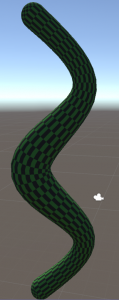
    Textured spline volumeshowing a snake that gets thicker towards the middle.
    Ball B-spline representation of a primitive snake. A tasty rabbit meal is contained in the midst of its body (thicker area).
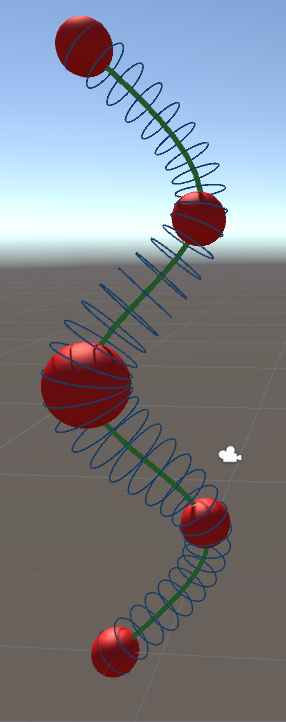
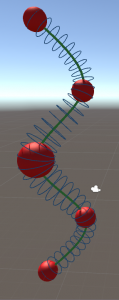
    Underlying skeleton of key-spheres, interpolated center curve and aligned circles the visualize the radii.
    Skeleton of the snake with key-spheres shown in red. The green line indicates the center position spline, the blue circles the radius at the respective position.

    For example, imagine how a snake eats and digests a rabbit. The victim’s body would slowly traverse from the snake’s head towards its tail. The resulting bulb in the snake’s body shape would slowly decrease during the prey’s travel through the digestive tract. Transferred to Ball B-Splines we could create a snake by defining some spheres, one for the head and a smaller one for the tail (and some along the sinus curve to make it snaky [ideally, one would sample at the extrema of the sinus function so that the polynomial is in shape even for only few keypoints).

    We can then model the tasty meal by an additional sphere somewhere between the snake’s head and its tail. The rabbit’s transition through the snake’s gut would simply be a movement of this sphere from head to tail (along the green center line) and a decrease in diameter simulates its digestion. Enjoy your meal.

    To highlight the elegance of the approach: In order to simulate how the snake is moving around, one would only need to move the few keypoints. The remainder of the mesh would move along with them accordingly.

    In the following posts I will go into more detail on the steps required to create such a Ball B-spline mesh. All sourcecode is availale at my github.


    This step is part of an approach to procedural tree modelling. Ao, Xuefeng, Zhongke Wu, and Mingquan Zhou proposed the Ball B-spline architecture to represent the tree skeleton: “Real time animation of trees based on BBSC in computer games.” International Journal of Computer Games Technology 2009 (2009): 5.

    A general introduction to Ball-B-splines (without many directly useful formulas, but more of an overview) is provided by Wu, Zhongke, Hock Soon Seah, and Mingquan Zhou. “Skeleton based parametric solid models: Ball B-Spline curves.” Computer-Aided Design and Computer Graphics, 2007 10th IEEE International Conference on. IEEE, 2007.
  • Thesis done :-)

    Thesis done 🙂

    My doctoral thesis on Scanpath Comparison Algorithms is published, you can grab a free copy at http://hdl.handle.net/10900/74458 or the compressed e-book version for online reading (with slightly less beautiful figures) at my university webpage.

  • Eye-tracking reveals the Pros in Mario Kart

    Eye-tracking reveals the Pros in Mario Kart

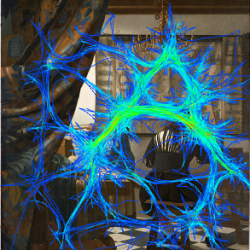
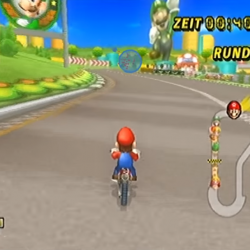
    Ever wondered how your eyes perform while playing a videogame? Turns out they might be quite important for you winning the game. Actually, so important that one can even distinguish whether you are a winner based solely on the movement of your eyes! And here is, what eye-tracking whilst gaming looks like:

    The small blue dots are called fixations, i.e. the spots where the eye rests at (even if it does so only shortly). During a fixation we actually perceive visual information. Fixations are interconnected by saccades, very very fast movements of the eye. In fact, they are so super-fast that our brain suppresses visual perception while we perform them. Try it with a mirror – you won’t be able to see your eyes moving when you look from one spot to the other.


    Eye-tracking data comparison

    So when you do an eye-tracking experiment, the result is just a list of fixation locations (and durations) and the saccades in-between. May look fancy on youtube, but doesn’t actually tell you anything meaningful most of the time. What you need to do is calculate some key metrics (such as the average time spent looking at the same location before shifting gaze; or the gaze density at certain game objects).

    Comparing eye movement sequences to each other as a whole (without the restriction to one specific key metric) is non-trivial (and I will likely cover this in a future post, as this is my PhD topic 😉 ). But if we do so, turns out that we can separate good players from novices quite well (Figure 1). It’s not just reactions that we train and getting to know the game better – but also a training effect in the patterns of how we need to move our eyes, that make a good player.

    The percentage of eye-tracking recordings that were correctly classified as either fast or slow drivers are shown on the diagonal. Off-diagonal elements (left top and bottom right) are misclassifications.
    Figure 1: The percentage of scanpaths classified correctly as either fast or slow drivers is shown on the diagonal. Off-diagonal elements (left top and bottom right) are misclassifications.

    T. C. Kübler, C. Rothe, U. Schiefer, W. Rosenstiel, E. Kasneci (2016): SubsMatch 2.0: Scanpath comparison and classification based on subsequence frequencies. Behavior Research Methods:1-17